Monday, January 24, 2011

Airport Bombing In Moscow

A bomb attack at Moscow's Domodedovo airport has killed at least 35 people and injured more than 100 - many of them critically, officials say.
Investigators say the explosion, which happened in the arrivals hall, was caused by a suicide bomber.
President Dmitry Medvedev vowed that those behind the attack would be tracked down and punished.
He ordered increased security across Russia's capital, its airports and other transport hubs.
Mr Medvedev also called an emergency meeting with officials and also postponed his planned departure for this week's World Economic Forum at Davos.
The airport - the busiest serving Russia's capital - is 40km (25 miles) south-east of the city centre.
Russian investigators said two Britons were among the dead.
Footage from mobile phones showed the arrivals area filled with smoke, with bodies strewn across the floor, shortly after the attack around 1630 (1330 GMT).BBC security correspondent Gordon Corera said immediate suspicion about Monday's attack would fall on militants from the Caucasus region.
Militant groups fighting in the Caucasus know how important the perception that the president and prime minister provide a secure society is, and to undermine that is a key aspect of their aims, adds our correspondent.
Last March the Russian capital's underground system was rocked by two female suicide bombers from Russia's volatile Dagestan region, who detonated their explosives on the busy metro system during rush hour, killing 40 people and injuring more than 80.

Thursday, December 9, 2010

The Natural Environment

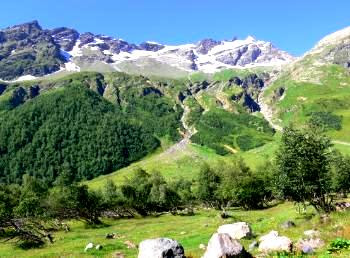
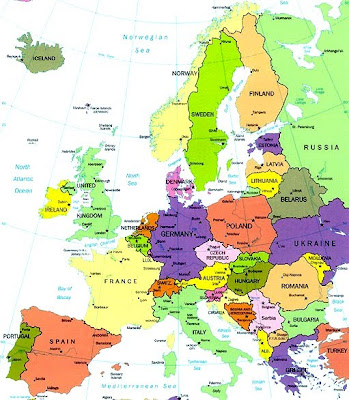
Europe is a highly fragmented landmass consisting of a number of large peninsulas, such as the Scandinavian, Iberian, and Italian, as well as smaller ones, such as the Kola, Jutland, and Brittany. It also includes a large number of offshore islands, notably Iceland, the British Isles, Sardinia, Sicily, and Crete (Kríti). Europe has coastlines on arms of the Arctic Ocean and on the North Sea and the Baltic Sea, in the north; on the Caspian Sea, in the southeast; on the Black Sea and the Mediterranean Sea, in the south; and on the Atlantic Ocean, in the west. The highest point of the continent is El’brus (5,642 m/18,510 ft), in the Caucasus Mountains in southwestern Russia. The lowest point of Europe is located along the northern shore of the Caspian Sea, 28 m (92 ft) below sea level.
Caucasus Mountains
Microsoft ® Encarta ® 2007. © 1993-2006 Microsoft Corporation. All rights reserved.

Thursday, October 28, 2010

The Netherlands Media

Under the Media Act of 1988, two national organizations coordinate radio and television broadcasting: an independent consortium provides production facilities, while a firm representing both government and the private sector transmits general-interest programming. Most programs are produced by nonprofit associations that are given funds raised by taxing radio and television owners and are allocated air time according to the number of members they have. The major producers include VARA (socialist), NCRV (Protestant), KRO (Roman Catholic), and AVRO and TROS (both nonsectarian). The country has many smaller producers, making Dutch radio and television pluralistic. In 1997 there were 980 radios and 542 televisions for every 1,000 people.
Microsoft ® Encarta ® 2007. © 1993-2006 Microsoft Corporation. All rights reserved.

Monday, October 18, 2010

Europe 20th century to present

Two World Wars and an economic depression dominated the first half of the 20th century. World War I was fought between 1914 and 1918. It started when Archduke Franz Ferdinand of Austria was assassinated by the Bosnian Serb Gavrilo Princip. Most European nations were drawn into the war, which was fought between the Entente Powers (France, Belgium, Serbia, Portugal, Russia, the United Kingdom, and later Italy, Greece, Romania, and the United States) and the Central Powers (Austria-Hungary, Germany, Bulgaria, and the Ottoman Empire). The War left around 40 million civilians and military dead. Over 60 million European soldiers were mobilised from 1914–1918.
Partly as a result of its defeat Russia was plunged into the Russian Revolution, which threw down the Tsarist monarchy and replaced it with the communist Soviet Union. Austria-Hungary and the Ottoman Empire collapsed and broke up into separate nations, and many other nations had their borders redrawn. The Treaty of Versailles, which officially ended World War I in 1919, was harsh towards Germany, upon whom it placed full responsibility for the war and imposed heavy sanctions.
Economic instability, caused in part by debts incurred in the First World War and 'loans' to Germany played havoc in Europe in the late 1920s and 1930s. This and the Wall Street Crash of 1929 brought about the worldwide Great Depression. Helped by the economic crisis, social instability and the threat of communism, fascist movements developed throughout Europe placing Adolf Hitler of Nazi Germany, Francisco Franco of Spain and Benito Mussolini of Italy in power.

By the end of World War II, the European economy had collapsed with 70% of the industrial infrastructure destroyed.
In 1933, Hitler became the leader of Germany and began to work towards his goal of building Greater Germany. Germany re-expanded and took back the Saarland and Rhineland in 1935 and 1936. In 1938, Austria became a part of Germany too, following the Anschluss. Later that year, Germany annexed the German Sudetenland, which had become a part of Czechoslovakia after the war. This move was highly contested by the other powers, but ultimately permitted in the hopes of avoiding war and appeasing Hitler.
Shortly afterwards, Poland and Hungary started to press for the annexation of parts of Czechoslovakia with Polish and Hungarian majorities. Hitler encouraged the Slovaks to do the same and in early 1939, the remainder of Czechoslovakia was split into the Protectorate of Bohemia and Moravia, controlled by Germany, and the Slovak Republic, while other smaller regions went to Poland and Hungary. With tensions mounting between Germany and Poland over the future of Danzig, the Germans turned to the Soviets, and signed the Molotov-Ribbentrop Pact. Germany invaded Poland on 1 September 1939, prompting France and the United Kingdom to declare war on Germany on 3 September, opening the European theatre of World War II. The Soviet invasion of Poland started on 17 September and Poland fell soon thereafter.
On 24 September, the Soviet Union attacked the Baltic countries and later, Finland. The British hoped to land at Narvik and send troops to aid Finland, but their primary objective in the landing was to encircle Germany and cut the Germans off from Scandinavian resources. Nevertheless, the Germans knew of Britain's plans and got to Narvik first, repulsing the attack. Around the same time, Germany moved troops into Denmark, which left no room for a front except for where the last war had been fought or by landing at sea. The Phoney War continued.
In May 1940, Germany attacked France through the Low Countries. France capitulated in June 1940. However, the British refused to negotiate peace terms with the Germans and the war continued. By August Germany began a bombing offensive on Britain, but failed to convince the Britons to give up. In 1941, Germany invaded the Soviet Union in the ultimately unsuccessful Operation Barbarossa. On 7 December 1941 Japan's attack on Pearl Harbor drew the United States into the conflict as allies of the British Empire and other allied forces.
After the staggering Battle of Stalingrad in 1943, the German offensive in the Soviet Union turned into a continual fallback. In 1944, British and American forces invaded France in the D-Day landings, opening a new front against Germany. Berlin finally fell in 1945, ending World War II in Europe.
The war was the largest and most destructive in human history, with 60 million dead across the world. More than 40 million people in Europe had lost their lives by the time World War II ended, including between 11 and 17 million people who perished during the Holocaust. The Soviet Union lost around 27 million people during the war, about half of all World War II casualties. By the end of World War II, Europe had more than 40 million refugees. Several post-war expulsions in Central and Eastern Europe displaced a total of about 20 million people.
The Schuman Declaration (9 May 1950) lead to the creation of the European Coal and Steel Community. It began the integration process which today comprises the European Union of 27 democratic countries in Europe.
World War I and especially World War II diminished the eminence of Western Europe in world affairs. After World War II the map of Europe was redrawn at the Yalta Conference and divided into two blocs, the Western countries and the communist Eastern bloc, separated by what was later called by Winston Churchill an "iron curtain". The United States and Western Europe established the NATO alliance and later the Soviet Union and Eastern Europe established the Warsaw Pact.

The two new superpowers, the United States and the Soviet Union, became locked in a fifty-year long Cold War, centred on nuclear proliferation. At the same time decolonisation, which had already started after World War I, gradually resulted in the independence of most of the European colonies in Asia and Africa. In the 1980s the reforms of Mikhail Gorbachev and the Solidarity movement in Poland accelerated the collapse of the Eastern bloc and the end of the Cold War. Germany was reunited, after the symbolic fall of the Berlin Wall in 1989, and the maps of Eastern Europe were redrawn once more. European integration also grew in the post-World War II years. The Treaty of Rome in 1957 established the European Economic Community between six Western European states with the goal of a unified economic policy and common market. In 1967 the EEC, European Coal and Steel Community and Euratom formed the European Community, which in 1993 became the European Union. The EU established a parliament, court and central bank and introduced the euro as a unified currency. In 2004 and 2007, Eastern European countries began joining, expanding the EU to its current size of 27 European countries, and once more making Europe a major economical and political centre of power.

Thursday, August 21, 2008

Europe 18th and 19th centuries

Europe 18th and 19th Centuries

The Age of Enlightenment was a powerful intellectual movement of the eighteenth century in which scientific and reason-based thought predominated. Discontent with the aristocracy and clergy's monopoly on political power in France resulted in the French Revolution and the establishment of the First Republic: the monarchy and many of the nobility perished during the initial reign of terror. Napoleon Bonaparte rose to power in the aftermath of the French Revolution and established the First French Empire that, during the Napoleonic Wars, grew to encompass large parts of Europe before collapsing in 1815 with the Battle of Waterloo.

Napoleonic rule resulted in the further dissemination of the ideals of the French Revolution, including that of nation-state, as well as the widespread adoption of the French model for administration, law and education. The Congress of Vienna was convened after Napoleon's downfall. It established a new balance of power in Europe centred on the five "great powers": the United Kingdom, France, Prussia, Habsburg Austria and Russia. This balance would remain in place until the Revolutions of 1848, during which liberal uprisings affected all of Europe except for Russia and Great Britain. The revolutions were eventually put down by more conservative elements and few reforms resulted. In 1867 the Austro-Hungarian empire was formed; and 1871 saw the unifications of both Italy and Germany as nation-states from smaller principalities.

The Industrial Revolution started in Great Britain in the last part of the 18th century and spread throughout Europe. The invention and implementation of new technology resulted in rapid urban growth, mass employment and the rise of a new working class. Reforms in social and economic spheres followed, including the first laws on child labour, the legalization of Trade Unions and the abolition of slavery. In Britain the Public Health Act of 1875 was passed, which significantly improved living conditions in many British cities.


HOME

Wednesday, August 20, 2008

Europe Early Modern Period

Europe Early Modern Period

The Renaissance was a period of cultural change originating in Italy in the fourteenth century. The rise of a new humanism was accompanied by the recovery of forgotten classical and Arabic knowledge from monastic libraries and the Islamic world. The Renaissance spread across Europe between the 14th and 16th centuries: it saw the flowering of art, philosophy, music, and the sciences, under the joint patronage of royalty, the nobility, the Roman Catholic Church, and an emerging merchant class. Patrons in Italy, including the Medici family of Florentine bankers and the Popes in Rome, funded prolific quattrocento and cinquecento artists such as Raphael, Michelangelo, and Leonardo da Vinci.

Political intrigue within the Church in the mid-14th century caused the Great Schism. During this forty-year period, two popes—one in Avignon and one in Rome—claimed rulership over the Church. Although the schism was eventually healed in 1417, the papacy's spiritual authority had suffered greatly. The Church's power was further weakened by the Protestant Reformation of Martin Luther, a result of the lack of reform within the Church. The Reformation also damaged the Holy Roman Empire's power, as German princes became divided between Protestant and Roman Catholic faiths. This eventually led to the Thirty Years War (1618-1648), which crippled the Holy Roman Empire and devastated much of Germany. In the aftermath of the Peace of Westphalia, France rose to predominance within Europe.

The Renaissance and the New Monarchs marked the start of an Age of Discovery, a period of exploration, invention, and scientific development. In the 15th century, Portugal and Spain, two of the greatest naval powers of the time, took the lead in exploring the world. Christopher Columbus reached the New World in 1492, and soon after the Spanish and Portuguese began establishing colonial empires in the Americas. France, the Netherlands and England soon followed in building large colonial empires with vast holdings in Africa, the Americas, and Asia.


HOME

Tuesday, August 19, 2008

Europe Middle Ages

Europe Middle Ages

The Middle Ages were dominated by the two upper echelons of the social structure: the nobility and the clergy. Feudalism developed in France in the Early Middle Ages and soon spread throughout Europe. The struggle between the nobility and the monarchy in England led to the writing of the Magna Carta and the establishment of a parliament. The primary source of culture in this period came from the Roman Catholic Church. Through monasteries and cathedral schools, the Church was responsible for education in much of Europe.

The Papacy reached the height of its power during the High Middle Ages. The East-West Schism in 1054 split the former Roman Empire religiously, with the Eastern Orthodox Church in the Byzantine Empire and the Roman Catholic Church in the former Western Roman Empire. In 1095 Pope Urban II called for a crusade against Muslims occupying Jerusalem and the Holy Land. In Europe itself, the Church organized the Inquisition against heretics. In Spain, the Reconquista concluded with the fall of Granada in 1492, ending over seven centuries of Muslim rule in the Iberian Peninsula.

In the 11th and 12th centuries, constant incursions by nomadic Turkic tribes, such as the Kipchaks and the Pechenegs, caused a massive migration of Slavic populations to the safer, heavily forested regions of the north. Like many other parts of Eurasia, these territories were overrun by the Mongols. The invaders, later known as Tatars, formed the state of the Golden Horde, which ruled the southern and central expanses of Russia for over three centuries.

Europe was devastated in the mid-14th century by the Black Death, one of the most deadly pandemics in human history which killed an estimated 50 million people in Europe alone - a third of the European population at the time. This had a devastating effect on Europe's social structure; it induced people to live for the moment as illustrated by Giovanni Boccaccio in The Decameron (1353). It was a serious blow to the Roman Catholic Church and led to increased persecution of Jews, foreigners, beggars and lepers.

HOME

Monday, August 18, 2008

Europe Dark Ages

Europe Dark Ages

During the decline of the Roman Empire, Europe entered a long period of change arising from what historians call the "Age of Migrations". There were numerous invasions and migrations amongst the Ostrogoths, Visigoths, Goths, Vandals, Huns, Franks, Angles, Saxons, and, later still, the Vikings and Normans. Renaissance thinkers such as Petrarch would later refer to this as the "Dark Ages". Isolated monastic communities were the only places to safeguard and compile written knowledge accumulated previously; apart from this very few written records survive and much literature, philosophy, mathematics, and other thinking from the classical period disappeared from Europe.

During the Dark Ages, the Western Roman Empire fell under the control of Celtic, Slavic and Germanic tribes. The Celtic tribes established their kingdoms in Gaul, the predecessor to the Frankish kingdoms that eventually became France. The Germanic and Slav tribes established their domains over Central and Eastern Europe respectively. Eventually the Frankish tribes were united under Clovis I. Charlemagne, a Frankish king of the Carolingian dynasty who had conquered most of Western Europe, was anointed "Holy Roman Emperor" by the Pope in 800. This led to the founding of the Holy Roman Empire, which eventually became centred in the German principalities of central Europe.

The Eastern Roman Empire became known in the west as the Byzantine Empire. Based in Constantinople, they viewed themselves as the natural successors to the Roman Empire. Emperor Justinian I presided over Constantinople's first golden age: he established a legal code, funded the construction of the Hagia Sophia and brought the Christian church under state control. Fatally weakened by the sack of Constantinople during the Fourth Crusade, the Byzantines fell in 1453 when they were conquered by the Ottoman Empire.

HOME

Sunday, August 17, 2008

Europe Classical Antiquity

Europe Classical Antiquity

Ancient Greece had a profound impact on Western civilization. Western democratic and individualistic culture are often attributed to Ancient Greece. The Greeks invented the polis, or city-state, which played a fundamental role in their concept of identity. These Greek political ideals were rediscovered in the late 18th century by European philosophers and idealists. Greece also generated many cultural contributions: in philosophy, humanism and rationalism under Aristotle, Socrates, and Plato; in history with Herodotus and Thucydides; in dramatic and narrative verse, starting with the epic poems of Homer; and in science with Pythagoras, Euclid, and Archimedes.

Another major influence on Europe came from the Roman Empire which left its mark on law, language, engineering, architecture, and government. During the pax romana, the Roman Empire expanded to encompass the entire Mediterranean Basin and much of Europe. Stoicism influenced emperors such as Hadrian, Antoninus Pius, and Marcus Aurelius, who all spent time on the Empire's northern border fighting Germanic, Pictish and Scottish tribes. Christianity was eventually legitimized by Constantine I after three centuries of imperial persecution.

Saturday, August 16, 2008

Europe Prehistory

Europe Prehistory

Homo georgicus, which lived roughly 1.8 million years ago in Georgia, is the earliest hominid to have been discovered in Europe. Other hominid remains, dating back roughly 1 million years, have been discovered in Atapuerca, Spain. Neanderthal man (named for the Neander Valley in Germany) first migrated to Europe 150,000 years ago and disappeared from the fossil record about 30,000 years ago. The Neanderthals were supplanted by modern humans (Cro-Magnons), who appeared around 40,000 years ago. During the latter part of this era, a period of megalith construction took place, with many megalithic monuments such as Stonehenge being constructed throughout Europe.

In terms of human society, Prehistoric Europe was inhabited first by nomadic bands, subsequently followed by tribal cultures. Early city-states and states spread broadly from the Fertile Crescent outward around 5000 BC. This led to the various Persian empires and the city-states of Ancient Greece around 700 BC.


HOME

Friday, August 15, 2008

Europe Etymology

Europe Etymology

In ancient Greek mythology, Europa was a Phoenician princess whom Zeus abducted after assuming the form of a dazzling white bull. He took her to the island of Crete where she gave birth to Minos, Rhadamanthus and Sarpedon. For Homer, Europe (Greek: Ερώπη, Eurpē; see also List of traditional Greek place names) was a mythological queen of Crete, not a geographical designation. Later Europa stood for mainland Greece, and by 500 BC its meaning had been extended to lands to the north.

Etymologically, the dominant theory suggests the name Europe is derived from the Greek roots meaning broad (eur-) and eye (op-, opt-), hence Eurpē, "wide-gazing" (compare with glaukōpis (grey-eyed) Athena or boōpis (ox-eyed) Hera). Broad has been an epithet of Earth itself in the reconstructed Proto-Indo-European religion. A minority, however, suggest that it is really based on a Semitic word such as the Akkadian erebu meaning "to go down, set", cognate to Phoenician 'ereb "evening; west" and Arabic Maghreb, Hebrew ma'ariv. See also Erebus, PIE *h1regwos, "darkness".

Most major world languages use words derived from "Europa" to refer to the continent. Chinese, for example, uses the word Ōuzhōu (歐洲), which is an abbreviation of the transliterated name Ōuluóbā zhōu (歐羅巴洲); however, the Turkish people used the term Frengistan (land of the Franks) in referring to much of Europe.


HOME

Thursday, August 14, 2008

Europe History and Facts

Europe History and Facts

Europe is one of the traditional seven political continents, and a peninsular sub-continent of the geographic continent Eurasia. Europe is bounded to the north by the Arctic Ocean, to the west by the Atlantic Ocean, to the south by the Mediterranean Sea, and to the southeast by the Caucasus Mountains, the Black Sea and the waterways connecting the Black Sea to the Mediterranean. To the east, Europe is generally divided from Asia by the water divide of the Ural Mountains, the Ural River, and by the Caspian Sea.

Europe covers about 10,180,000 square kilometres (3,930,000 sq mi) or 2% of the Earth's surface and about 6.8% of the planet's total land area. It hosts a large number of sovereign states (ca. 50), whose precise number depends on the underlying definition of Europe's border, as well as on the inclusion or exclusion of semi-recognized states. Europe contains parts of Russia, the world's largest country by area and Europe's largest by area and population, as well as the Vatican, the smallest country on both counts. Europe is the third most populous continent after Asia and Africa with a population of 731,000,000 or about 11% of the world's population. According to UN population projection (medium variant), Europe's share will fall to 7% in 2050, numbering 653 million. However, Europe's borders and population are in dispute, as the term continent can refer to a cultural and political distinction or a physiographic one.

Europe is the birthplace of Western culture. European nations played a predominant role in global affairs from the 16th century onwards, especially after the beginning of colonization. By the 17th and 18th centuries European nations controlled most of Africa, the Americas, and large portions of Asia. World War I and World War II led to a decline in European dominance in world affairs as the United States and Soviet Union took prominence. The Cold War between those two superpowers divided Europe along the Iron Curtain. European integration led to the formation of the Council of Europe and the European Union in Western Europe, both of which have been expanding eastward since the fall of the Soviet Union in 1991.

The term "Europe" has multiple uses. Its principal ones are geographical and political.

* Geographically, Europe is the westernmost peninsula of the continent of Eurasia; its limits are well defined by sea to the North, South and West. The Ural mountains are usually taken as the eastern limit of Europe, along with the Ural River, and the Caspian Sea. Europe can be considered bounded to the southeast by the Caucasus Mountains, the Black Sea and the waterways connecting the Black Sea to the Mediterranean. Europe's eastern and southeastern extent are discussed below.

* Politically, Europe comprises those countries in the European Union, but may at times be used formally or more casually to refer to both the EU together with other non-EU countries e.g. the Council of Europe has 47 member countries and includes the 27 countries which are part of the EU.

* In addition, people in countries such as Ireland, United Kingdom, Scandinavia and the North Atlantic and Mediterranean islands, may routinely refer to "continental" or "mainland" Europe simply as Europe or "the Continent".

HOME

Sunday, July 27, 2008

Thousands of homes without water

Thousands of homes without water

BBC News channel


About 15,000 properties in south London were left without water for about seven hours on what was one of the hottest days of the year.

Thames Water said a major water main burst on Merton High Street in south-west London on Sunday morning, cutting supplies to customers.

Engineers managed to fix the leak and supplies were back on by mid-afternoon.

Some shops had to ration bottled water after people rushed for supplies as temperatures rose to about 30C.

Kingston, Merton, Wimbledon and Surbiton were among the affected areas.

Tesco in Kingston brought in rations of 12 two-litre bottles or three five-litre bottles of water per customer.

'Absolute disaster'

Bart Ricketts, a borough councillor in Kingston, said: "Sainsbury's in Surbiton was nearly sold out of water when I went there at 2pm.

"Families needed water even more in the hot weather but fortunately it wasn't off for too long."

A spokesman for Thames Water had earlier apologised for the inconvenience and said people with special needs, such as those with young children or people looking after the sick or elderly, could call the company's customer services for advice.

Thomas Hoskins, who lives in Wimbledon, south-west London, earlier told BBC London the problem was an "absolute disaster on a day like this".

Chris Gleeson from Raynes Park said: "I just went to the bathroom and turned on the tap to find no water, so I haven't been able to have a shower or flush the toilet.

"We do have bottled water so we've had a cup of tea this morning but it is causing real problems."

The incident also caused travel disruption with Merton High Street closed in both directions while the burst main was repaired.

South Wimbledon Station was shut due to flooding but later reopened.

Sunday, July 20, 2008

My Links to the Best Blogs

http://asiabulletin.blogspot.com/

http://americaupdate.blogspot.com/

http://saudiupdate.blogspot.com/

http://newyorkcityfinest.blogsome.com/

http://rosesredlove.blogsome.com/

http://canadatourmanager.blogsome.com/

http://catslovely.blogsome.com/

http://chinatourmanager.blogsome.com/

http://dogslovely.blogsome.com/

http://floridatourguide.blogsome.com/

http://flowerslovers.blogsome.com/

http://francetourguide.blogsome.com/

http://greecetourguide.blogsome.com/

http://italytourguide.blogsome.com/

http://japanhistorian.blogsome.com/

Monday, July 7, 2008

Second arrest over student deaths

Second arrest over student deaths
Gabriel Ferez and Laurent Bonomo
The two students were stabbed repeatedly and set alight

A second man has been arrested by police hunting the killer of two French students.

Gabriel Ferez and Laurent Bonomo, both 23, were killed in a frenzied attack at a rented bedsit in New Cross, south-east London, on 29 June.

A police spokesman said a 33-year-old man handed himself in at a south London police station and had since been taken to hospital for treatment to injuries.

A 21-year-old man arrested on Saturday has been released without charge.

The badly burned bodies of Mr Bonomo, from Velaux, near Marseille and Mr Ferez, from Prouzel, near Amiens, were found with more than 240 stab wounds.

Post-mortem examinations gave the cause of death in both cases as multiple stab wounds to the head, neck and torso.

Tests also revealed Mr Bonomo suffered 80 wounds after he died.

The flat in Sterling Gardens, New Cross, which Mr Bonomo was renting, had been burgled on 23 June and a laptop was stolen.

Detectives believe their bank cards and two Sony PSP games consoles were taken on the day the pair were killed.

They have urged anyone who has been offered games consoles stolen from the flat to come forward.

Mr Ferez's parents said in a statement to those behind the killings: "Rest assured that we will not leave you in peace."

They also said his killer would "not be able to live in hiding forever".

Both men were biochemistry students and were in the third year of a masters degree at Polytech Clermont-Ferrand in central France.

They were in London because they had been chosen to take part in a research project at Imperial College and were due to return home within weeks.